
When a load is damaged beyond practical recovery, freight disposal services can help a broker, shipper, carrier, or 3PL move from a shipment crisis to a documented resolution. They provide a clear next step when a shipment cannot continue as planned. The right response starts with identifying the cargo, separating what can still be recovered, and coordinating a responsible path for material that should not return to normal distribution.
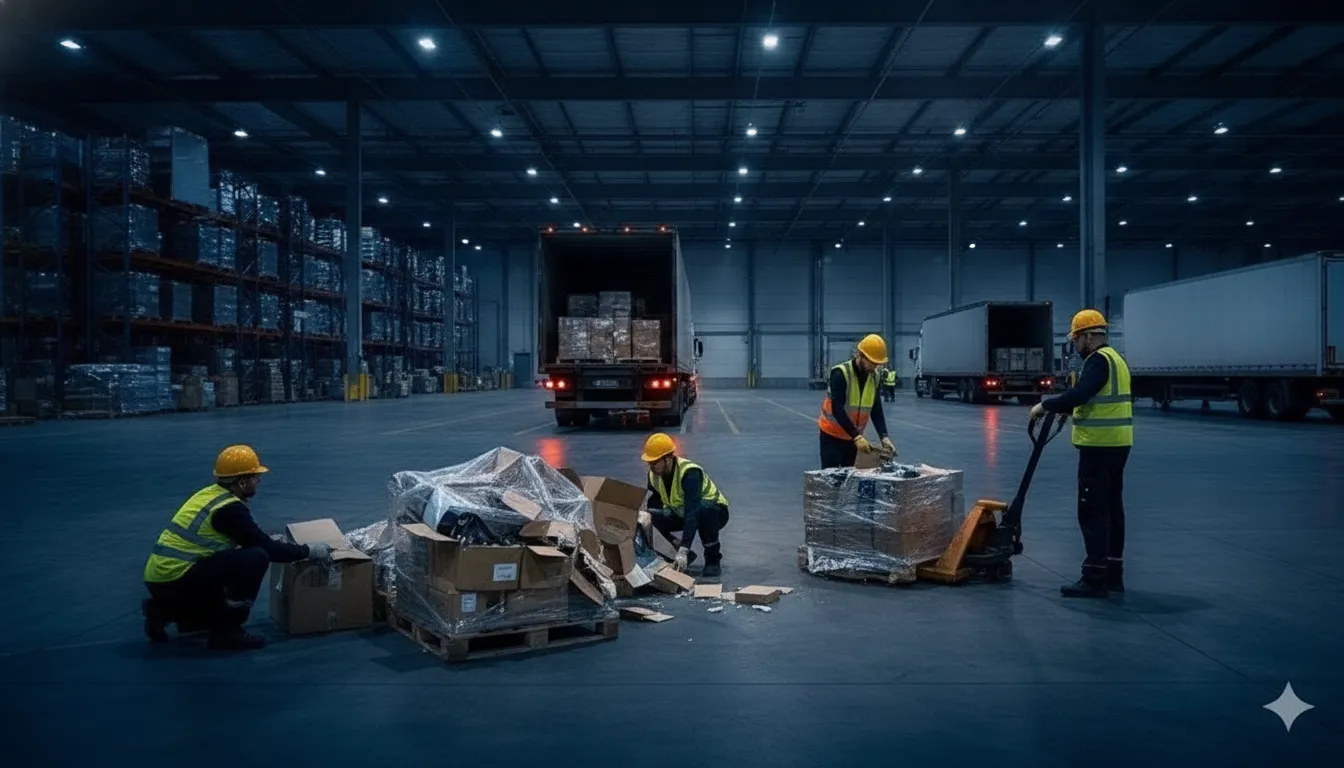
Contact us now for help with damaged or unsalvageable freight.
What Are Freight Disposal Services and When Are They Required?
Freight disposal is the controlled removal, destruction, recycling, or other approved disposition of cargo that cannot be delivered, sold, returned, or safely reintroduced into the supply chain. A professional freight disposal service coordinates the practical work around that decision, including load assessment, sorting, on-site labor, transportation, facility coordination, and documentation.
Disposal may be considered when cargo has been damaged in transit, rejected by a receiver, recalled, contaminated, compromised by temperature or water exposure, or rendered unsalable by packaging failure. It can also be necessary when the cost or risk of recovery is greater than the cargo’s usable value. The decision should be based on the product condition and the responsible party’s instructions, not on an assumption that every damaged load belongs in a dumpster.
Disposal is a disposition decision, not simply a hauling job
Moving a damaged shipment out of a trailer does not resolve the underlying problem. The load may still need to be inspected, counted, separated, secured, transferred, or documented before its final disposition. If products are removed without a clear chain of responsibility, the same shipment can create new confusion around claims, inventory records, customer communication, and unauthorized resale.
A practical freight disposal plan answers five questions:
- What happened to the shipment, and who has authority to direct its disposition?
- Which units are recoverable, reworkable, returnable, or unsalvageable?
- Where is the freight located, and what access or time constraints apply?
- Does the cargo require a specialized handling or disposal channel?
- What records should be created before the work is closed?
These questions are also useful when a shipment needs more than disposal. WeFixFreight’s freight disposal and responsible cargo elimination guide provides broader context for choosing between disposal, salvage, rework, and related remediation options.
Types of Cargo That Require Professional Freight Disposal
Professional freight disposal is most useful when the cargo condition, shipment value, or operational pressure makes an informal solution risky. The exact response depends on the product and the instructions from the owner, shipper, receiver, insurer, or other authorized party.
Common examples include:
- Severely damaged freight: Products crushed, punctured, soaked, broken, or otherwise unable to meet the expected delivery condition.
- Rejected or refused loads: Cargo that a receiver will not accept because of condition, packaging, count, temperature, timing, or other shipment-specific concerns.
- Recalled or withdrawn products: Goods that must be removed from the distribution flow and handled according to the owner’s written direction.
- Contaminated or compromised cargo: Products affected by leakage, exposure, cross-contamination, or an unknown condition that prevents normal delivery.
- Unsaleable product: Freight that may be physically intact but cannot be distributed because its packaging, labeling, shelf condition, or commercial status has changed.
- Mixed-condition shipments: Loads where some units can be recovered while other units require disposal or controlled destruction.
Mixed-condition freight is especially important to evaluate carefully. A full trailer should not automatically be treated as one category. Sorting may identify units for rework, re-delivery, return, salvage review, or disposal. This can reduce unnecessary loss while keeping compromised units out of the normal fulfillment process.
When specialized handling may be needed
Some cargo requires a response beyond ordinary freight labor. If the shipment may contain regulated materials, liquids, chemicals, food products, medical items, batteries, or other sensitive goods, identify that fact before moving or opening the load. The person directing the work should provide accurate product information and any available handling instructions. WeFixFreight can coordinate the logistics and on-site response, while the cargo owner and qualified disposal partners determine the appropriate approved channel for the material.
This distinction matters because freight disposal services should not guess about the final treatment of a product. A responsible provider can help assess the operational problem and coordinate the next step without making unsupported legal or environmental promises.
How Responsible Freight Disposal Works: Compliance and Process
Responsible freight disposal begins with a controlled handoff. The objective is to protect people, cargo information, facilities, and the supply chain while creating a clear record of what happened. Requirements vary by product, condition, location, and disposal method, so the process should be adapted to the shipment rather than forced into a generic checklist. OSHA’s material-handling and storage standard emphasizes stable storage and secure placement of materials; see 29 CFR 1910.176 for the applicable material-handling reference.
1. Confirm the shipment and the decision-maker
Start with the basic facts: shipment reference, location, product description, approximate quantity, packaging condition, and the reason the freight cannot continue normally. Confirm who has authority to approve rework, return, salvage review, or disposal. This prevents a carrier, warehouse, broker, and shipper from receiving conflicting instructions.
2. Inspect and separate the load
Before final disposition, inspect the freight from a safe position and separate obvious categories. Depending on the situation, those categories may include deliverable units, rework candidates, returnable units, salvage candidates, and cargo that should not reenter distribution. Photos, counts, and notes can help the responsible parties understand the condition without relying on memory after the load is gone.
3. Choose a documented disposition path
The approved path may involve disposal, recycling, controlled destruction, product return, short-term warehousing, transloading, or another specialized project. The correct choice depends on the cargo and the owner’s direction. If the freight must remain secure while that decision is made, short-term freight warehousing can help create time and space for an orderly resolution.
4. Coordinate labor, equipment, and location constraints
Freight disposal may require unloading, sorting, pallet handling, restacking, transfer, cleanup coordination, or movement between facilities. A good plan accounts for dock hours, trailer access, facility rules, equipment availability, and the need to keep other operations moving. When the work occurs at a location that cannot absorb a delayed trailer or blocked dock, speed and coordination are part of the solution.
5. Close the record
At the end of the work, retain the information needed by the parties responsible for the shipment. That may include the final count, disposition instructions, photos, service notes, transfer details, and confirmation that the assigned work was completed. The exact record depends on the customer and cargo, but the principle is consistent: do not let the physical removal of freight create a documentation gap.
WeFixFreight can coordinate this type of response as part of a broader remediation plan. Its approved service mix includes product disposal, freight re-work, cross-docking, transloading, on-site labor, and specialized projects, so the answer can change when the load assessment changes.
What to prepare before requesting freight disposal services
A faster handoff starts with practical details. Gather the shipment reference, current location, trailer or warehouse status, product description, approximate unit count, photos, and any written direction from the cargo owner. Note whether the load is blocking a dock, approaching a facility deadline, or subject to a receiver refusal. Also identify the person authorized to approve disposal, salvage review, return, or rework. These details help the response team distinguish an urgent labor need from a larger disposition project and coordinate the right location, equipment, and service-agent coverage. Clear scope also limits delays, duplicate handling, and conflicting instructions at the facility.
Freight Disposal vs Freight Salvage: What Is the Difference?
Freight disposal and freight salvage are different disposition paths. Disposal is used when cargo is not suitable for normal commerce and must be removed through an approved method. Salvage is an evaluation of whether some value can still be recovered through an authorized channel. A load can require both processes when part of the shipment is recoverable and the remaining units are not.
| Question | Freight disposal | Freight salvage |
|---|---|---|
| Primary goal | Resolve cargo that should not continue in normal distribution. | Evaluate whether authorized value can be recovered. |
| Typical outcome | Controlled removal, destruction, recycling, or another approved disposition. | Transfer or sale through an approved salvage process, when permitted. |
| Key concern | Keeping compromised or unauthorized product out of the supply chain. | Preserving value without creating brand, safety, or distribution problems. |
| Can they overlap? | Yes. One shipment can include disposal units and salvage candidates. | Yes. Salvage review may happen before the final disposal decision. |
The right question is not simply whether a product has any residual value. The decision should also consider authorization, condition, traceability, market restrictions, brand protection, and the practical cost of holding or moving the freight. If those factors are unclear, pause the disposition and obtain direction from the party responsible for the cargo.
WeFixFreight’s product disposal service is designed for situations where a shipment needs an organized path out of the distribution process. If the load instead needs sorting, transfer, or another recovery step first, the response can be coordinated around that requirement.
How WeFixFreight Handles Freight Disposal Nationwide
WeFixFreight helps freight brokers, shippers, carriers, and 3PLs respond when cargo problems threaten delivery, warehouse capacity, customer commitments, or claim resolution. The company operates as an urgent, on-demand freight remediation specialist, with 24/7 availability and a nationwide network of more than 150 service agents.
That model is useful when the shipment is not located near the original shipper or when a standard provider cannot handle the combination of time pressure and cargo complexity. WeFixFreight can help coordinate:
- Initial information gathering and response planning.
- On-site labor for unloading, sorting, counting, or handling.
- Product disposal and responsible cargo elimination coordination.
- Freight re-work, pallet services, cross-docking, and transloading when recovery is possible.
- Short-term warehousing when the load needs a controlled place to wait.
- Specialized projects that do not fit a routine transportation plan.
The company also maintains direct relationships with service agents and uses transparent, standardized pricing. A quote is based on the actual situation, including the cargo, location, labor, equipment, timing, and requested scope. Customers should receive clear expectations before work begins, without relying on a one-size-fits-all assumption about a freight crisis.
When you contact WeFixFreight, be ready to share the load location, shipment condition, approximate quantity, receiver or facility restrictions, and the outcome you need. If the cargo is damaged, refused, recalled, or otherwise unsalvageable, that information helps the response team determine whether the immediate need is disposal, sorting, rework, transfer, storage, or a combination of services.
For broader complex-load support, WeFixFreight also coordinates specialized freight projects when a shipment requires a plan beyond a standard pickup or delivery.
Frequently Asked Questions About Freight Disposal Services
What are freight disposal services?
Freight disposal services coordinate the assessment, handling, removal, destruction, recycling, or other approved disposition of cargo that cannot continue through normal distribution. The response may include sorting, on-site labor, transfer, storage, and documentation.
When should I call a freight disposal provider?
Call when cargo is damaged, rejected, recalled, contaminated, unsaleable, or blocking a trailer, dock, or warehouse. Early coordination can help separate recoverable units from freight that requires disposal.
Can damaged freight be salvaged instead of disposed of?
Sometimes. A qualified review may identify units that can be returned, reworked, or moved through an authorized salvage process. The remaining units may still need a separate disposal path.
Does WeFixFreight handle freight disposal nationwide?
WeFixFreight provides nationwide emergency freight remediation through a network of more than 150 service agents and 24/7 availability. The available response depends on the cargo, location, timing, and requested scope.
What information should I provide when requesting help?
Provide the load location, shipment or reference number, product type, approximate quantity, damage or rejection reason, trailer or facility constraints, and the outcome you need. Photos and written disposition instructions can also help.
Contact us now to coordinate a responsible freight disposal response.