
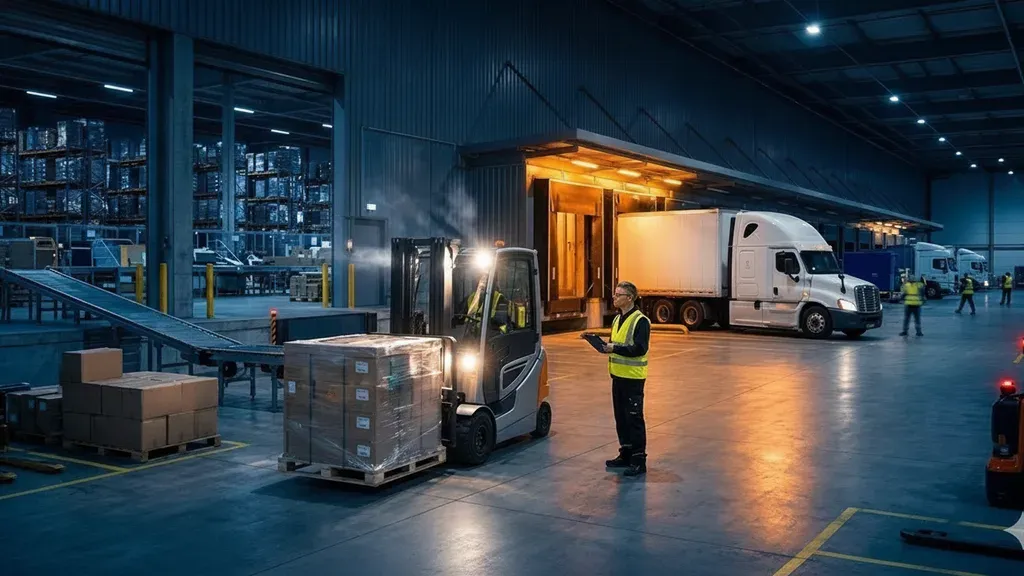
When fallen pallets at a warehouse interrupt receiving, a freight broker has to protect people, preserve the shipment record, and coordinate the next move without guessing what can be released. The right response is a controlled warehouse workflow: secure the dock area, inspect and count the freight, confirm what the receiver and carrier will accept, and arrange pallet restacking or freight re-work before the load moves again. For the service that addresses unstable or disorganized freight, see emergency pallet restacking service.
Contact us now for help with fallen pallets at a warehouse
What should a broker do when pallets fall at a warehouse?
A broker should treat the incident as a warehouse safety and shipment-control problem before treating it as a routine delivery delay. Ask the facility to stop work around the affected freight, keep people out of the fall zone, and avoid forcing a leaning or collapsed pallet upright. Then collect the facility address, on-site contact, trailer or load number, pallet count, photos, visible damage, and the receiver’s immediate requirements.
Next, align the shipper, carrier, warehouse, and cargo owner on one question: what must happen before this freight can be safely handled or released? The answer may be a controlled restack, broader freight re-work, sorting and inspection, a cross-dock, short-term warehousing, or a new delivery appointment. A broker’s job is not to prescribe a lift from a desk. It is to coordinate qualified work and keep every party operating from the same facts.
Step 1: Stabilize the warehouse scene before handling freight
Warehouse personnel should control the immediate area before anyone starts cleanup. A fallen pallet can leave loose cartons, broken boards, exposed product, stretch wrap, banding, and other trip or impact hazards around a dock or staging lane. If freight is leaning against another pallet, rack, trailer wall, or door, the visible condition may not show the full risk.
- Pause forklift, pallet-jack, and foot traffic around the affected area.
- Keep drivers, visitors, and unassigned employees outside the work zone.
- Do not ask a driver or untrained person to pull, push, climb, or hand-restack unstable freight.
- Confirm whether the trailer, dock plate, rack, floor, or other equipment has damage.
- Assign one warehouse contact to communicate with the broker and response team.
OSHA’s material handling and storage standard addresses securing stored material against sliding, falling, or collapse. That principle supports a controlled work area and a deliberate inspection before the warehouse resumes normal handling.
Step 2: Inspect and count the fallen pallet load
Once the area is controlled, the warehouse contact should document what is known before freight is moved. The broker can use the information to coordinate the right service and to keep the shipper and carrier from making decisions from incomplete descriptions.
| What to document | Why it matters | Useful examples |
|---|---|---|
| Location and access | Determines where labor and equipment can work | Dock door, staging lane, trailer position, receiving hours, floor access |
| Pallet and piece counts | Creates a baseline for sorting, rework, and release | Whole pallets, partial pallets, loose cases, missing or segregated units |
| Physical condition | Separates stabilization from broader freight re-work | Broken boards, crushed cartons, torn wrap, wet cases, leaning stacks |
| Shipment identity | Connects the warehouse event to the correct load and customer | Bill of lading, trailer number, seal, purchase order, labels |
| Receiver requirements | Defines what can be accepted and released | Inspection, relabeling, repalletizing, photos, new appointment, approval |
Take photos from safe positions before cleanup, including the affected pallet footprint, labels, surrounding freight, damaged packaging, and any visible equipment condition. Keep the original images and record the time, person reporting the condition, and information that still needs confirmation. Do not describe all freight as damaged when the evidence shows only a partial pallet event.
Step 3: Decide whether the load needs a restack or full freight re-work
A restack may be appropriate when the product is substantially intact and the main problem is a collapsed, leaning, or unstable pallet configuration. The work can include removing loose material, rebuilding the pallet, repositioning cases, replacing wrap, and securing the load for the next handling event.
Broader freight re-work may be needed when the warehouse finds damaged packaging, mixed or unidentified product, broken pallets, moisture, contamination concerns, or receiver requirements that go beyond simple stabilization. The difference matters because a pallet that looks upright is not necessarily ready to ship. The work plan should account for the condition of the product, the packaging, the pallet base, the labels, and the next transportation step.
For a warehouse that needs labor and handling support at the facility, on-site labor services may be part of the response. The broker should confirm the needed equipment, work area, expected pallet or piece count, commodity requirements, and facility rules before dispatch.
Step 4: Get the right approvals before moving or releasing freight
The warehouse can report what it sees, but the authority to approve a disposition may belong to the shipper, cargo owner, receiver, carrier, or another designated party. Make the approval path explicit before the work begins.
- Warehouse: confirms access, equipment, staffing, hours, and what the facility can physically receive or release.
- Carrier: confirms trailer status, driver instructions, seal requirements, equipment changes, and the next transportation step.
- Broker or 3PL: keeps the parties aligned, records the decision, and communicates timing without overstating the condition.
- Shipper or cargo owner: approves rework, hold, return, disposal, product release, or another cargo decision when required.
- Receiver: confirms acceptance criteria, revised appointment, labeling needs, and any required documentation.
If the receiver refuses the load until it is restacked or inspected, capture that condition in writing. If the carrier cannot safely continue with the current configuration, record the carrier’s requirement rather than treating a new trailer as an automatic solution. Clear approvals prevent a reworked pallet from being sent to a destination that will reject it again.
Step 5: Choose the next warehouse or transportation move
After the pallet condition and approvals are known, select the smallest controlled next step that solves the operational problem. The options below are not interchangeable, and more than one may be needed.
- Restack in place: use when the warehouse has suitable space, equipment, labor, and approval to rebuild the affected pallet safely.
- Freight re-work: use when the load needs repalletizing, packaging correction, sorting, replacement materials, or a more complete condition review.
- Cross-dock: use when the freight can move directly from an inbound trailer or controlled staging area to an outbound trailer without unnecessary storage. The emergency cross-docking service guide explains the broader transfer decision.
- Transload: use when the original equipment, route, or transportation mode no longer fits the recovered load. See transloading services for the transfer use case.
- Short-term warehousing: use when the freight is recoverable but the next carrier, appointment, repair, or release decision is not ready. Short-term warehousing can protect the shipment while that decision is coordinated.
- Re-delivery coordination: use when the receiver has rejected the shipment or the recovered load needs a new appointment. Re-delivery services can support the next delivery plan.
For example, a broker may coordinate a controlled restack at the receiving warehouse, document the new pallet count, move the recovered freight to a replacement trailer, and obtain a revised appointment before dispatch. That is a warehouse response workflow, not a generic instruction to find a vendor and move on.
Step 6: Document the warehouse release
Before the recovered freight leaves the facility or changes custody, create a release record that connects the original incident to the next move. The record should include:
- Before-and-after photos tied to the shipment or trailer identifier
- Final pallet, case, and piece counts, including held or segregated freight
- A note describing the work completed, such as restacking, rewrapping, repalletizing, sorting, or transfer
- Labels, seal details, trailer information, and any changed handling instructions
- Receiver or shipper approval, revised appointment, or other release authorization
- The name of the warehouse contact and the carrier or facility receiving the next handoff
Use the release record to communicate one concise status update: what happened, what was found, what was done, what remains held, and what happens next. This reduces repeated calls and gives the broker a defensible timeline without making unsupported claims about liability or product disposition.
Contact us now to coordinate fallen pallet rework at your warehouse
Frequently asked questions
Can fallen pallets at a warehouse be restacked in place?
Sometimes. The warehouse must have a controlled work area, suitable equipment, capable labor, and approval for the work. If packaging, pallet bases, counts, labels, or product condition also need correction, the load may require broader freight re-work instead of a simple restack.
What information should a broker collect first?
Collect the exact facility location, on-site contact, trailer or load number, photos, pallet and piece counts, visible damage, receiver requirements, access limits, and the next delivery deadline. Separate confirmed observations from assumptions so the response is matched to the actual condition.
Who approves the next move after a warehouse pallet collapse?
The approval path depends on the shipment and the parties involved. The warehouse controls site access and facility work, while the shipper, cargo owner, receiver, carrier, broker, or 3PL may approve rework, release, storage, a new trailer, or a new delivery appointment. Identify the decision owner before dispatch.
When should a broker use cross-docking after a pallet falls?
Cross-docking may fit when the freight can be made ready for transfer and needs to move from an inbound trailer or staging area to an outbound trailer without a longer storage stop. Confirm the recovered count, condition, equipment, labor, receiving window, and outbound appointment first.
What should the warehouse document before releasing the load?
Document the condition before and after work, final counts, damaged or held units, work completed, labels, seal and trailer details, approvals, and the next handoff. A complete release record helps the broker, carrier, shipper, and receiver act from the same shipment history.