
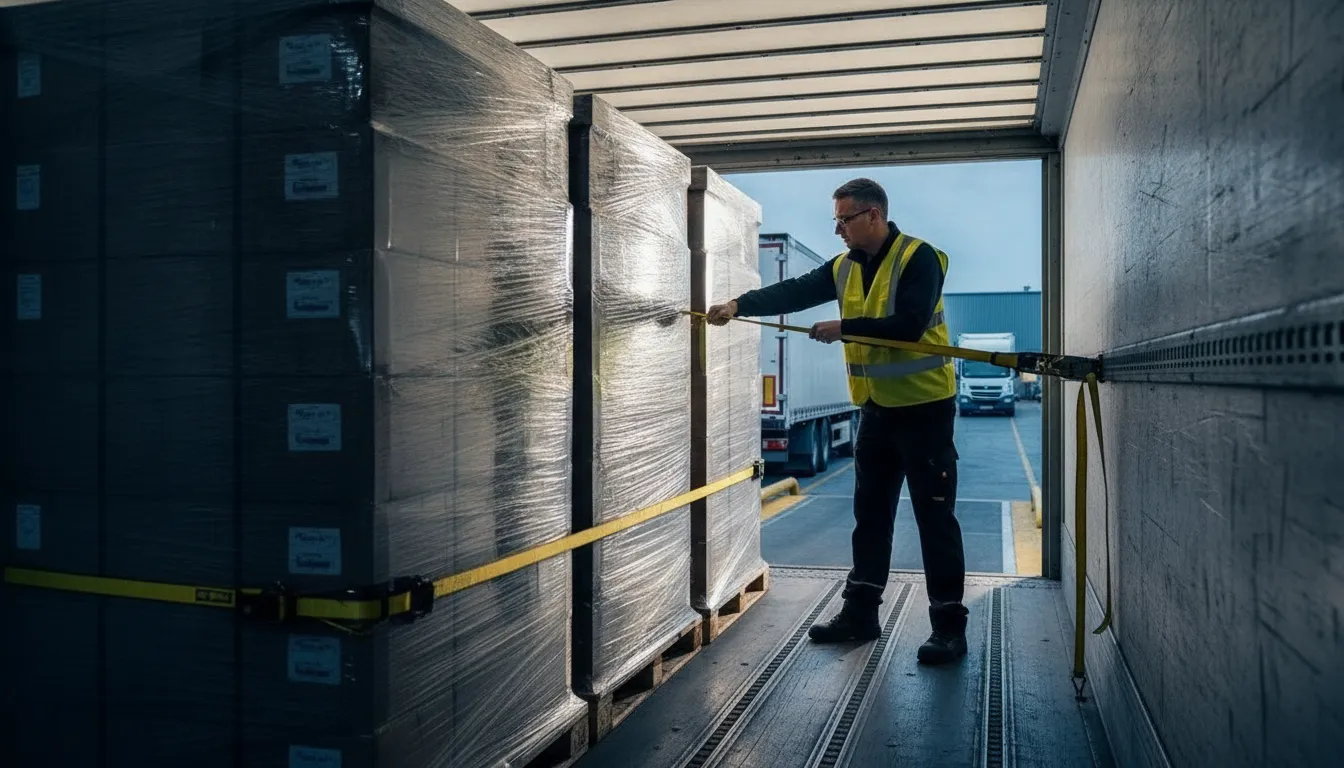
A pallet can leave a loading dock stable and arrive with shifted cartons, leaning stacks, or damaged product. Braking, cornering, uneven roads, poor weight distribution, and gaps between units can turn a routine haul into a rework event. Securement must account for the entire load, not just the final strap.
Contact us now for emergency pallet rework and restack services.
To prevent pallet shifting in trailer loads, distribute weight evenly, load pallets squarely, remove damaged pallets, close gaps with suitable dunnage, and use securement devices with adequate working load limits. Inspect the load and securement before departure and again during the trip.
These steps reduce movement, but they work best when matched to the forces a trailer experiences in transit. Even with disciplined loading, some shipments still require emergency pallet rework and restack services when freight in crisis has already moved. First, it helps to understand why pallets shift, including how acceleration, braking, lateral movement, and load balance expose weaknesses in an otherwise orderly shipment.
Why Pallets Shift During Transport
Pallet movement usually begins with a loading decision that seems minor: uneven weight, a gap between units, or a pallet placed slightly out of square. Once the trailer is moving, those small weaknesses are exposed by braking, turning, rough pavement, and sudden lane changes. For brokers, shippers, and carriers, understanding the cause is the first step toward preventing pallet shifting in trailer operations and avoiding damage, delays, and unsafe unloading conditions.
Vehicle forces expose weak loading decisions
A loaded trailer is not a stationary storage area. Freight is subjected to forward, rearward, and lateral forces throughout a trip. Under FMCSA cargo securement standards, the securement system must restrain cargo against forward deceleration of 0.8g. Rearward acceleration of 0.5g, and lateral acceleration of 0.5g during conditions such as emergency maneuvers. FMCSA explains these force requirements as part of the standard for preventing cargo from shifting or falling.
When a pallet is not adequately restrained, braking can drive it toward the front of the trailer. A sharp turn can push it sideways, while acceleration can open gaps between adjoining pallets. Once one unit moves, it can strike neighboring freight and create a chain reaction. The result may be crushed product, broken pallets, a leaning stack, or a load that cannot be safely accessed at the destination.
Weight distribution and center of gravity matter
Weight must be distributed throughout the trailer rather than concentrated in one area. Heavy pallets placed poorly can affect vehicle stability and increase the likelihood of movement, especially when the load is combined with insufficient restraint. Improper weight distribution and unsecured freight are recognized safety risks because they can contribute to vehicle instability and road accidents. The FMCSA cargo-shifting standard connects securement with safe vehicle operation.
Loading pallets squarely helps keep the center of gravity balanced. A pallet set at an angle, left with excessive space, or positioned inconsistently with the surrounding units has more opportunity to rotate or slide. Where possible, pallets should be centered appropriately or placed tightly against the trailer walls, based on the cargo and the securement plan. The objective is not simply to fill available space. It is to create a stable, supported load that can withstand movement in every direction.
A pre-trip review should therefore examine more than the straps or bars. Confirm that pallet weight is distributed sensibly, individual units are square and stable, and no gap or leaning stack can become a movement path. These checks support broader freight damage prevention strategies before the trailer leaves the dock.
Load Securement Methods To Prevent Pallet Shifting in a Trailer
Effective securement uses multiple controls together. The Federal Motor Carrier Safety Administration requires cargo on a commercial motor vehicle to be contained, immobilized. Or secured so it cannot shift or fall in a way that affects vehicle stability or safe operation. Its guidance also addresses forces from forward deceleration, rearward acceleration, and lateral movement. So a pallet that looks stable at the dock still needs protection against braking, turns, lane changes, and uneven pavement. Review the FMCSA cargo securement rules before establishing loading procedures.
Combine bars, straps, and void control
Load bars and ratchet straps are standard tools for immobilizing pallets inside an enclosed trailer. Position bars where they can limit forward, rearward, or lateral movement, and apply straps according to the freight, trailer configuration, and equipment design. Pallets should be loaded squarely and, where appropriate, placed tightly against the trailer walls or toward the center to support a stable center of gravity. Avoid leaving open space that allows a unit to build momentum.
Fill voids with properly selected dunnage or other filler material. Dunnage helps maintain the structure of the load when pallet dimensions do not create a tight, continuous pack. It should support the freight without crushing cartons, blocking doors, or creating a new hazard. Securement is not a substitute for sound loading. A damaged pallet, unstable stack, or loose product should be corrected before the trailer leaves the dock.
| Securement method | What it controls | Best used when |
|---|---|---|
| Ratchet straps and chains | Forward, rearward, and vertical movement. | Heavy or high-profile pallets that need positive tie-down. |
| Load bars | Lateral and forward movement between walls. | Enclosed trailers with a tight side-to-side fit. |
| Dunnage and filler | Voids and gaps between or around units. | Loads that do not pack into a continuous block. |
| Shrink-wrap | Cohesion of cartons within each unit. | Palletized product that must stay together. |
| Non-slip or rubber mats | Friction between pallet base and floor. | Smooth-floor trailers carrying dense pallets. |
| Corner protectors | Strap pressure and edge damage. | Fragile or banded freight under tension. |
Increase unit integrity and floor friction
Shrink-wrap palletized goods so the individual cartons or products function as a more stable unit. Wrapping should be tight enough to maintain cohesion, but it should not be treated as the sole restraint for a heavy or high-risk load. Place non-slip or rubber mats between the pallet base and trailer floor when suitable for the freight and operating conditions. Added friction can reduce sliding, while bars, straps, dunnage, and correct placement address movement from other directions.
Use corner protectors beneath straps when tension could cut into cartons, banding, or other freight. Protectors distribute pressure across the load edge and help preserve product integrity as the strap is tightened. Confirm that every chain, strap, bar, or other securement device has a visible Working Load Limit marking. Use each device within its design and rating, and make sure the combined system is appropriate for the cargo.
Inspect before departure
A pre-trip inspection should check for frayed webbing, cuts, stretched straps, bent bars, damaged fittings, loose hardware, and missing or unreadable WLL markings. Replace defective equipment rather than relying on additional tension or improvised repairs. Confirm that pallets, wrap, dunnage, and restraints remain in position after the doors are closed and before departure. Include securement checks in documented loading procedures. Then follow the required en-route inspection process so a developing problem is found before it becomes freight damage, a delivery delay, or emergency rework.
For broader freight damage prevention strategies, connect securement decisions with pallet inspection, loading discipline, and monitoring throughout transit.
How Stacking Pattern Affects Load Stability
A pallet can be properly wrapped and still become unstable when the load pattern creates weak columns, an uneven center of gravity, or pressure at the trailer doors. Stacking decisions should account for pallet condition, freight weight, trailer geometry, and the movement that occurs during braking, turning, and unloading.
Build stable columns, not unsupported towers
Vertical stacking can use trailer space efficiently, but pallets stacked one above another need adequate structural support. When a column has no suitable frame or other support, the upper pallets can shift independently of the lower pallet. That uneven movement can lead to column failure and a collapse during transit. Do not stack damaged or irregular pallets simply to fill unused vertical space. Confirm that the pallet design, product packaging, and available restraint system can support the planned height before loading.
Start with a stable base and keep each pallet square. A leaning base creates a problem that straps alone may not correct. If the load requires a different arrangement, use dunnage, filler, load bars, or other appropriate securement rather than forcing gaps closed with unstable freight.
Inspect every pallet before it enters the trailer
A sound stacking pattern cannot compensate for a compromised pallet. Before moving a pallet, inspect its condition, stability, and structural integrity. Look for broken boards, missing deck boards, loose nails, and protruding nails. These defects can reduce support, damage adjacent freight, or allow the load to settle and shift after the trailer starts moving. The CDC pallet safety guidance specifically identifies these conditions as inspection concerns: inspect pallets for broken boards, missing deck boards, and loose or protruding nails.
Remove questionable pallets from the loading plan until they are repaired, replaced, or safely reworked. This inspection is especially important when pallets will be stacked, because a defect at the bottom of a column can affect every unit above it.
Balance weight from the axles to the doors
Place the heaviest pallets over the trailer axles when the load plan allows. This supports balanced weight distribution and improves overall stability. Load pallets squarely toward the center of the trailer or tightly toward the walls, depending on the available space and securement plan. A consistent center of gravity reduces opportunities for lateral movement and helps the restraint system work as intended.
Keep freight from being piled too close to the trailer doors. A load pressed against the doors can tip when the doors open, creating a door failure and an immediate safety problem during unloading. Leave the door area arranged so the freight remains stable when restraints are released and the trailer is opened. For additional freight damage prevention strategies, review the full loading and inspection process before dispatch.
When Prevention Fails: Recognizing a Shifting Load Early
Even a carefully loaded trailer can develop movement after braking, turning, rough pavement, or repeated vibration. The first warning is rarely a dramatic collapse. More often, a pallet begins to lean, the alignment between units changes, or a strap develops visible slack. Treat those changes as a cargo security issue, not a cosmetic problem. Lateral movement is a common cause of pallet damage because repeated side-to-side force can loosen cartons, break stretch wrap, and push neighboring pallets out of alignment.
Look for small changes before they become a load failure
During a stop, compare the load with its original condition. A pallet that no longer sits squarely, a gap that has opened between pallets. Or a stack that tilts toward a trailer wall can indicate that the securement system is losing control. Check whether load bars remain seated and whether straps are still tensioned across the intended contact points. If a pallet has shifted laterally, do not assume tightening one strap will solve the underlying problem. The load may need to be isolated, supported, or reworked before the trailer continues.
Inspect securement equipment before every trip and whenever the load is checked. FMCSA guidance calls for straps, chains, and bars to be free from defects and fraying before use. A cut edge, stretched webbing, bent bar, damaged anchor point, or worn tensioning component can turn a stable load into a moving one. Remove defective equipment from service rather than compensating for it with improvised materials. Securement devices also need to be appropriate for the cargo and used within their marked Working Load Limit.
Use the first 50 miles as an early intervention point
Federal cargo securement rules require the driver to inspect the cargo and its securement within the first 50 miles of a trip. This early check confirms that the securement system has held. The inspection should focus on changes, not merely whether equipment is still present. Look for leaning pallets, slack straps, tilting alignment, collapsed wrapping, and movement toward the trailer doors or walls. The inspection rule is an opportunity to find a developing failure while the load can still be addressed safely. See the FMCSA cargo securement rules for the governing requirements.
Prompt action protects more than the product. When a shift delays delivery or requires freight rework, detention charges can reach $450 to $750 per day, according to WeFixFreight customer guidance. If the load is already leaning or has fallen, follow the steps to take when pallets shift and keep personnel clear of unstable freight. Do not force open doors or send untrained workers into a compromised trailer. Early recognition gives the carrier, broker, or shipper time to arrange a controlled response before damage, injury, and delay costs compound.
What to Do If Your Load Shifts Despite Securement
Once pallets move, the priority changes from prevention to controlled response. A shifted load can damage product, destabilize the trailer, create a delivery failure, and expose every party in the shipment chain to avoidable loss. Industry estimates put cargo theft and damage losses at $725 million in 2025. Which reinforces the need to treat a compromised load as an active operational risk, not a minor delay.
- Stop safely and assess the extent of the shift. Move to a safe location as soon as traffic and road conditions allow. Do not open the trailer in an unsafe area or rush into the cargo space. Check whether pallets are leaning, fallen, crushed, broken, or pressing against doors. Look for damaged straps, displaced load bars, broken dunnage, and product that has escaped its pallet. The first assessment should establish whether the freight can be safely reached and whether the trailer itself remains stable.
- Document the condition, and do not drive an unstable load. Take clear photographs of the trailer, pallets, securement devices, product damage, and surrounding conditions. Record the location, time, shipment details, and visible cause of the shift. Notify the broker, shipper, carrier, or 3PL according to the shipment’s escalation process. Do not continue toward delivery simply because the trailer can still move. An unstable load can shift again during braking, turning, or lane changes, increasing the chance of additional damage or a roadway incident.
- Call a freight remediation specialist when the load cannot be resecured on the road. If pallets have fallen, the securement system is compromised, or the freight cannot be safely handled with the equipment and labor on hand, stop attempting improvised repairs. WeFixFreight provides 24/7/365 emergency response for load shifts and freight rework. Its nationwide network of more than 150 service agents can coordinate specialized labor for the situation and location. Review pallet rework services to understand how damaged or unstable freight can be evaluated and restored for continued movement.
- Arrange on-site rework or cross-docking so the shipment can continue safely. A qualified crew may need to unload the trailer, inspect the freight, rebuild or restack pallets, replace damaged securement, and document the completed work. When the original trailer, route, or loading arrangement is no longer suitable, cross-docking remediation can move the shipment into a properly prepared trailer or staging area. This controlled handoff is safer than forcing a compromised load to its destination. For urgent pallet shifts, emergency pallet rework and restack services can provide on-site labor anywhere in the United States, helping brokers, shippers, carriers, and 3PLs reduce downtime while protecting the shipment.
Fast escalation preserves options. The sooner the load is isolated, documented, and placed with qualified remediation labor, the better the chance of limiting product damage, detention, and delivery disruption.
Contact us now for fast, nationwide freight rework and restack support.
Frequently Asked Questions
How do you stop pallets from shifting in a trailer?
Start with sound pallets, balanced placement, and intact shrink-wrap. Fill open spaces with appropriate dunnage, then use rated load bars or straps to immobilize the load. Non-slip material under pallet bases can also increase friction and reduce sliding. Inspect the trailer floor, pallets, and securement equipment before departure.
What is the best way to secure a load to prevent shifting?
Use a layered approach rather than relying on one device. Distribute weight evenly, place heavier freight where it supports trailer stability, block movement with dunnage, and apply straps or bars according to their Working Load Limit. The securement system must keep cargo from shifting under forward, rearward, and lateral forces. FMCSA specifies 0.8g forward and 0.5g rearward and lateral force requirements for cargo securement: FMCSA cargo securement force standards.
Are load bars effective at preventing shifting?
Yes, load bars can be effective when they fit the trailer correctly and are used with appropriate blocking, straps, or dunnage. They are not a substitute for sound loading practices. Check each bar for damage, confirm it is seated securely, and use equipment with a clearly marked Working Load Limit. Inspect securement before departure and after the load settles.
When should a driver inspect a secured load?
The driver should inspect the cargo and securement system before the trip, then perform an en-route inspection within the first 50 miles. Additional checks are prudent after hard braking, sudden maneuvers, rough road conditions, or any sign of movement. If pallets have shifted, stop safely and arrange qualified rework before continuing.
Contact us now when securement needs professional support
If pallets have shifted or your load needs immediate rework before delivery, the right response can help restore stability and keep the shipment moving. Contact us now to connect with We Fix Freight for 24/7 emergency freight rework and pallet restack services.