
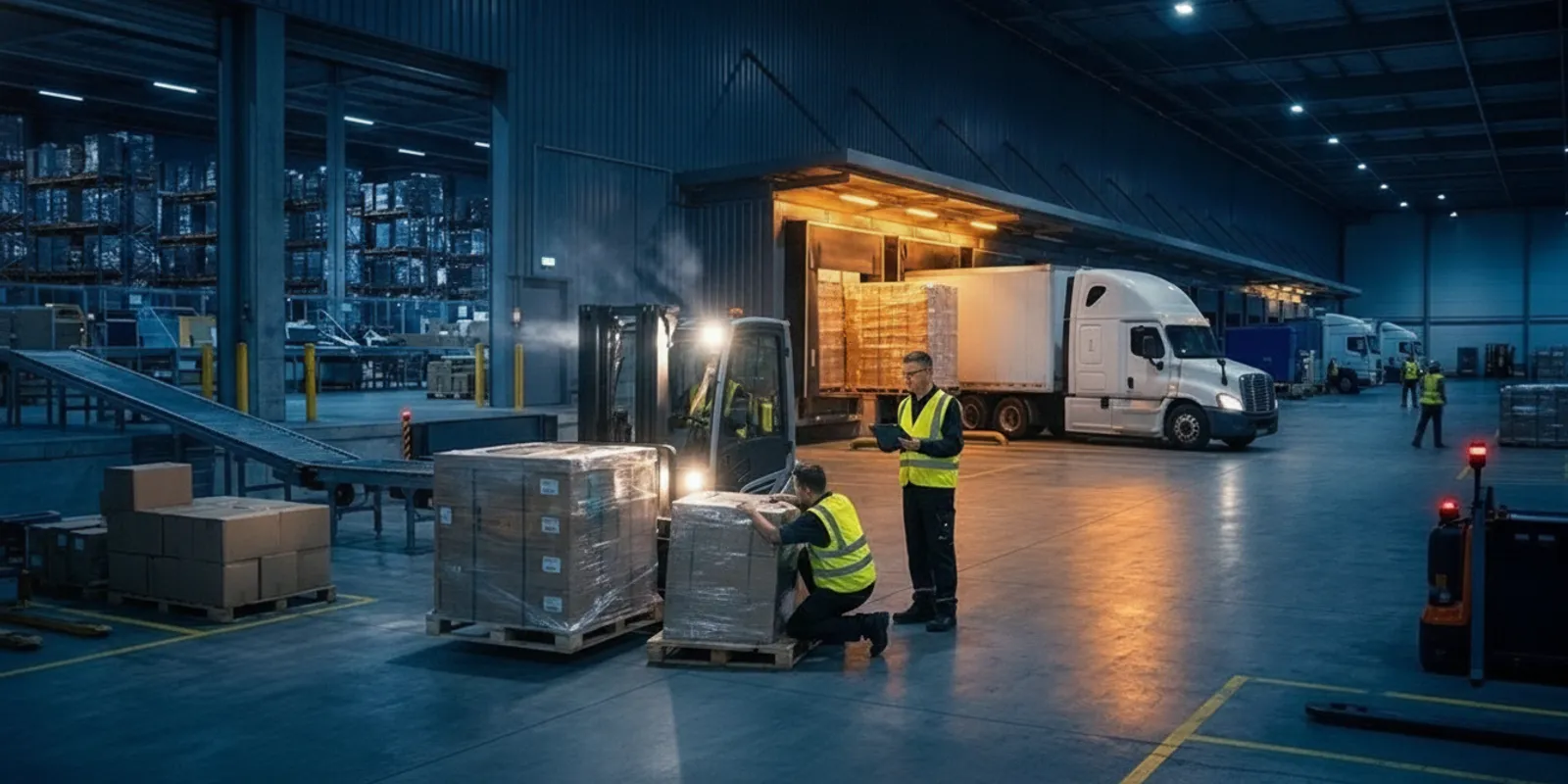
Restacking pallets at a consignee can turn a rejected or delayed delivery into a coordinated recovery, but the receiving team needs a clear plan before anyone starts moving freight. If you are a broker, shipper, carrier, or 3PL arranging restacking pallets at a consignee, first confirm why the load cannot be received as presented, what the site will accept, and who can approve the work.
What should you confirm before arranging a restack?
A consignee may reject a load because pallets are leaning, shifted, broken, unstable, or not arranged to its receiving requirements. Get the exact reason from the receiving contact rather than relying on a general note such as “pallet issue.” A specific reason helps you choose between repositioning, a pallet restack, broader freight re-work, or another delivery plan.
Ask the consignee to clarify:
- Which pallets or handling units are affected, and how many?
- What condition or arrangement prevents receiving?
- What pallet dimensions, height, stack pattern, wrapping, labeling, or separation does the site require?
- Can the site perform or host the work, or must a service provider be arranged?
- What are the dock access hours, appointment rules, equipment limits, and site safety requirements?
- Who can approve work, freight movement, and the revised delivery plan?
Ask for photos if the facility can provide them safely. Request images of the affected pallets, the full load where practical, and any labels or shipment identifiers needed to match the issue to the right freight. Do not ask staff to climb on freight or enter an unsafe area to take pictures.
Write down the receiving requirement in plain terms. “Restack to two pallets, keep these product lots separate, and deliver before the next appointment window” is more useful than “make it acceptable.” If the requirement is unclear, ask the site to confirm before authorizing labor or moving product.
It also helps to separate the receiver’s condition requirement from its scheduling requirement. A load can be physically corrected yet still miss the current appointment or be unable to enter the dock during the remaining shift. Ask whether the consignee will inspect the finished pallets immediately, whether an appointment change is needed, and how long the site can hold the freight. For example, if only two of twelve pallets need a new pattern, identify those two by location or label and confirm whether the other ten can remain untouched. This limits unnecessary handling and gives the authorizing party a precise scope to approve.
How can you assess the load without making the situation worse?
Start with the people responsible for the freight and the receiving site. A driver or warehouse employee may be able to report what they see, but that does not automatically authorize them to unload, rebuild, discard, or release cargo. Confirm who has authority to approve handling and follow the site’s safety procedures.
Keep people clear of unstable pallets and do not attempt an improvised restack. A load that looks manageable from outside may have shifted inside the trailer or may be carrying weight unevenly. If there is a risk of collapse, damaged packaging, leaking contents, or an unknown product hazard, stop handling and notify the responsible site contact. Use qualified personnel and suitable equipment for the conditions. OSHA provides workplace safety information through its official website; follow applicable workplace requirements and the facility’s own procedures.
Gather the key shipment details in one place:
- Pickup and consignee locations, current location, and delivery appointment details.
- Load or shipment reference, product description, pallet count, and any lot or temperature requirements.
- What the receiving team observed and the specific acceptance requirement.
- Photos, inspection notes, and the name or role of the person providing the information.
- Available dock, labor, equipment, and time-window details.
- Any limits on separating, rewrapping, re-palletizing, or moving the freight.
A documented inspection can help teams distinguish a local pallet issue from broader damage or a load shift. See this freight inspection process guide for the kinds of observations to organize before a rework decision. If the freight has shifted in transit, the response may require more than a simple pallet correction; this guide to a shifted load covers the coordination questions to raise.
Record the condition before any work starts, using shipment identifiers in the notes so that photographs do not become separated from the load record. Note whether the wrap is torn, whether cartons are crushed or exposed, whether labels remain readable, and whether product appears to have moved within its packaging. These observations are not a substitute for a formal damage assessment, but they help the decision-maker understand whether the request is limited to pallet arrangement or may involve product condition. If the load cannot be inspected safely in its current position, say so and wait for an approved safe method rather than asking someone to reach into a compromised stack.
Which recovery option fits the consignee’s requirements?
Match the response to the actual problem and the receiver’s acceptance criteria. Do not assume every rejected pallet needs the same treatment. A restack may be enough when the product is intact and the issue is pallet stability or configuration. More extensive freight re-work may be needed if pallets, packaging, or the arrangement must be corrected before release.
| Situation | Potential response | Confirm before work |
|---|---|---|
| Pallets are leaning or shifted, with product apparently intact | Repositioning or restacking pallets into an acceptable, stable arrangement | Required pallet count, pattern, height, wrap, and handling instructions |
| A pallet is broken or cannot support the freight | Freight re-work, potentially including transfer to a suitable replacement pallet | Who supplies materials, how product is handled, and approval to rebuild |
| Several pallets need sorting, separation, or renewed preparation | Broader freight re-work with on-site labor as appropriate | Product identification, lot separation, labels, work area, and equipment |
| The consignee cannot accept the load or provide access for correction | Coordinate an alternate facility, cross-docking, or re-delivery plan | New destination, appointment, custody, transportation, and authorization |
The table is a planning aid, not an instruction to handle freight without approval. The responsible parties must agree on scope, site access, and disposition before work begins. For a broader overview of available freight re-work support, review the service information and match the request to the shipment’s condition.
Consider a simple example: the consignee reports that one pallet is leaning but says the cartons appear intact. If inspection confirms the issue is limited to the pallet base and the receiver gives a clear required pattern, a focused restack may address the rejection. If the same inspection finds damaged cartons, mixed product lots, or unreadable labels, the scope must change. Get approval for those additional tasks rather than treating them as included in the original restack. This distinction helps avoid surprise work, disputed counts, and a load that is still rejected after the first correction.
When hands are needed at the receiving location, on-site labor services may be relevant to the plan. If the consignee cannot receive the freight after correction, ask whether re-delivery is the right next step. A transfer to a different location may call for cross-docking or another coordinated move instead. Treat each option as a separate decision, since it can affect custody, appointments, and transportation.
How do you coordinate the work with the receiving team?
Once the receiving requirement is clear, align the people who control the freight, facility, and transportation. This can include the shipper, broker, carrier, consignee, and the party arranging service. One person should track approvals and updates so the work does not proceed on conflicting instructions.
- Confirm the scope. Record which pallets are affected, what must change, and what must remain untouched. Confirm whether freight can be opened, separated, or transferred to another pallet.
- Confirm authority. Identify who can approve the work and any additional approval needed from the cargo owner or receiver. Do not treat silence as approval.
- Confirm the site plan. Verify the correct address, check-in process, dock or work area, access window, equipment availability, and any facility-specific rules.
- Arrange qualified labor and equipment. Describe the load condition accurately so the response can be planned around the actual freight and site constraints.
- Set the release criteria. Agree on what completed work should look like and who will inspect or accept it. Confirm how labels, counts, and product separation will be checked.
- Update transportation. Reconfirm whether the truck will wait, return to a dock, move to another facility, or require a new delivery appointment. Communicate changes to all affected parties.
- Close the record. Keep the work notes, before-and-after photos where available, updated pallet count, approval trail, and receiving outcome with the shipment file.
Before dispatch, send one concise work summary to every party who needs to act. Include the reference number, precise location, number of pallets, approved scope, required finished configuration, access contact, and the next transportation decision. Ask each party to confirm the part they control, such as authorization, dock access, or appointment changes. If instructions change after labor is arranged, pause and circulate the revised scope so the crew and receiver are not working from different versions.
For a time-sensitive situation, sharing complete information early can reduce avoidable clarification. WeFixFreight coordinates urgent freight repair through a nationwide network of more than 150 service agents and is available 24/7. You can check the company’s freight re-work and re-delivery coverage while organizing the location details. Availability and the right response depend on the job, site, and freight requirements.
What can delay a consignee restack?
Several preventable gaps can keep freight from moving after the initial rejection:
- Vague instructions: A request to “fix the pallets” does not tell the team what the receiver will accept. Obtain a measurable requirement.
- Unclear authorization: Work can stall if the person on site lacks approval to alter, separate, or release freight.
- Missing site details: Incorrect dock hours, access instructions, equipment limits, or appointment information can prevent a planned response.
- Incomplete freight information: Unknown pallet counts, product identifiers, or handling restrictions may require additional checks before work begins.
- Assuming a restack resolves every issue: The load may have product damage, packaging concerns, or a separate delivery problem that needs its own decision.
- No agreed next move: Even a successful restack does not automatically create a delivery appointment or carrier plan.
Before confirming a provider, share the problem and the site’s criteria, then ask what information is still needed to assess the request. To explore the difference between a quick local fix and a larger service response, this guide to what pallet re-work involves can help frame the discussion. For a location-specific restack request, review the steps in the pallet restack guide as well.
How can the shipment team reduce repeat problems?
After the immediate issue is resolved, capture what caused the rejection and what acceptance condition was missed. Record the receiving team’s instructions in the shipment file and pass them to the people planning the next delivery or handling step. If the pallet arrangement, wrapping, labeling, or appointment process contributed, make the corrective action specific enough to use on the next load.
For recurring consignee requirements, confirm them before dispatch rather than relying on a driver to resolve a problem at the dock. A brief pre-delivery check can cover pallet configuration, product separation, labeling, appointment, and who to contact if the receiver identifies a concern. Keep this information tied to the applicable product and destination; one site’s rules should not be assumed to apply everywhere.
A useful closeout note should distinguish facts from assumptions. Record the receiver’s stated reason, the approved change, the result of the inspection, and whether the corrected freight was accepted. If it was not accepted, preserve the new reason and the decision about custody or next movement. Over time, these records can show whether repeated rejections relate to a particular destination requirement, a packaging step, or incomplete appointment communication. Use that pattern to update the relevant shipping checklist, then confirm the change with the receiving contact before the next similar shipment.
Frequently Asked Questions
Can pallets be restacked at the consignee’s dock?
Possibly, if the facility permits the work, the area is suitable, and the responsible parties approve the plan. Confirm dock access, labor, equipment, safety rules, and the receiver’s required finished configuration before arranging work.
What information should I send when requesting a restack?
Provide the location, shipment reference, pallet count, product and handling details, the consignee’s reason for rejection, the exact acceptance requirement, photos if safely available, access hours, and the name of the person who can approve the work.
Does a restack mean the freight is ready for delivery?
Not necessarily. The receiver may need to inspect the corrected load, and the shipment may still need a new appointment, carrier update, or alternate destination. Confirm acceptance and the next transportation step separately.
What if the consignee will not accept the shipment after the pallets are corrected?
Ask for the remaining reason for rejection and get an authorized decision on the next move. Depending on the circumstances, the team may need to plan re-delivery, a transfer, short-term warehousing, or another approved response.
Contact us to coordinate a consignee restack
Contact us now to discuss the freight and receiving requirements
Share the consignee’s acceptance criteria, the shipment details, and the current location so the response can be assessed and coordinated around the situation.